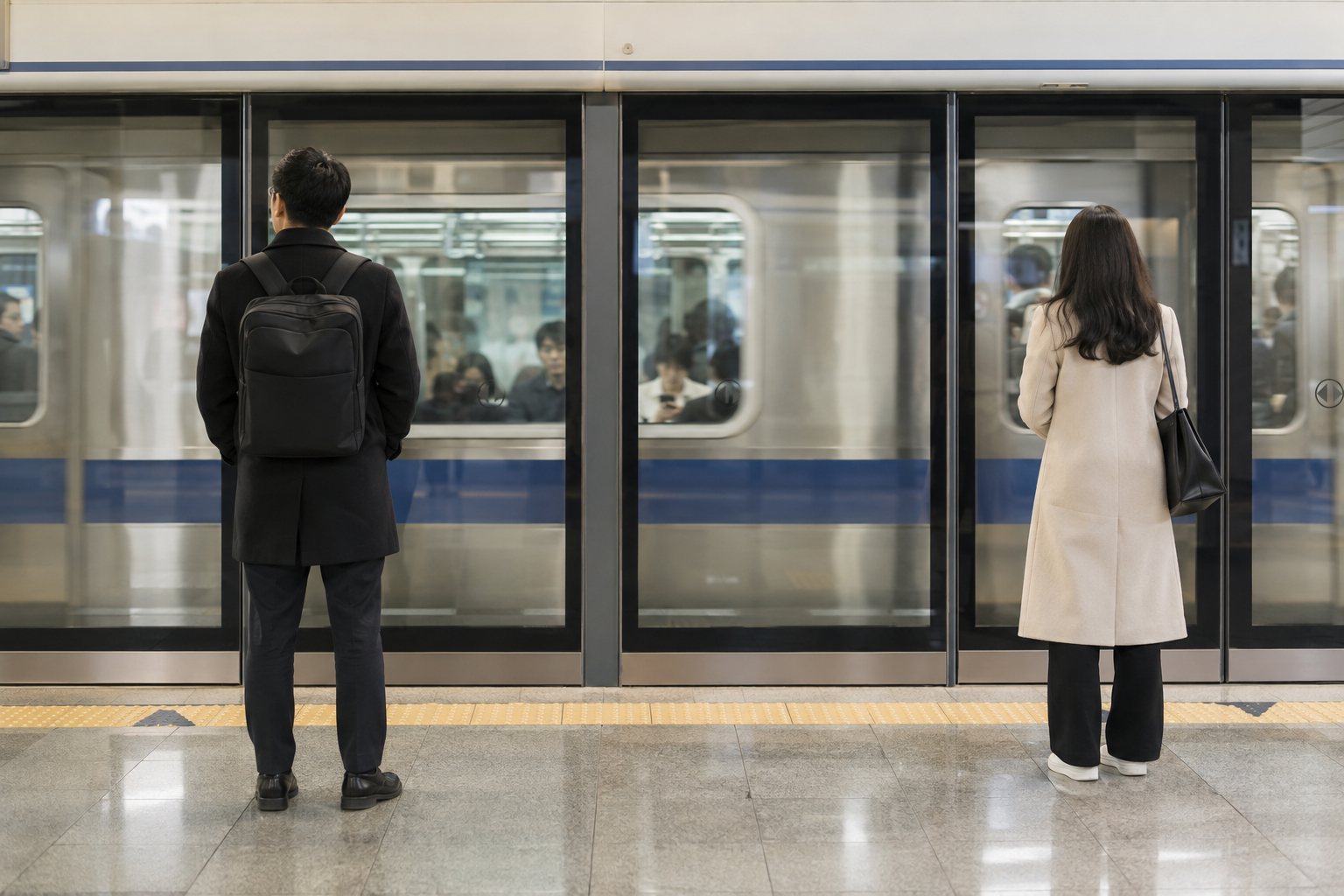
Your first Seoul subway ride becomes much easier when you separate three decisions: which ticket to use, which direction to board and which exit to take. The line colour alone will not answer all three.
Quick answer
For repeated journeys, use a supported prepaid transit card such as Tmoney or EZL and keep enough balance for your route. The standard adult base fare is ₩1,550 with a transit card; longer journeys and some services cost more. Tap in and out with the same card, follow transfer signs inside the station, and check the exit number for your final destination.
Choose a transit card or a single-journey ticket
| Option | What to know |
|---|---|
| Tmoney or EZL | A reusable prepaid transit card. Buying the card and loading travel balance are separate costs. Check the retailer’s stock and reload method. |
| Single-journey card | Buy for your destination at a station machine. This is a reusable plastic card, not a paper ticket. A refundable deposit is charged separately. |
| Foreign bank card | Not a universal tap-to-ride subway ticket. Selected machines accept international cards to buy eligible tickets; that does not make the bank card usable at every gate. |
| Climate Card | A separate pass with its own validity and route coverage. Check your exact trips, especially airport and out-of-Seoul journeys, before buying. |
Korea Tourism Organization’s transit-card guide explains Tmoney and EZL purchase and use. Carry won cash for an ordinary prepaid-card reload unless your chosen machine or retailer explicitly offers another supported method. Do not assume that buying a card by credit card also pays for its balance.
Seoul announced international-card payment at 440 new machines in 273 stations on Lines 1–8 in March 2026, for single-journey tickets and short-term Climate Card purchases/reloads. Availability and supported products matter; a service fee may apply. See the official machine notice and the amount displayed before paying.
Understand the fare before you enter
Seoul’s published adult base fare is ₩1,550 by transit card and ₩1,650 for a single journey, before its refundable deposit. These are base fares, not a flat price for every trip. Distance and the operators used can increase your total. Check your route’s estimated fare rather than multiplying every ride by ₩1,550.
For a single-journey card, select the correct destination, pay the displayed fare and deposit, then keep the card until after you exit. Use the deposit-refund machine at the destination to return it. Do not throw it away as if it were a disposable receipt.
Prepare one transit card per person for independent subway gate entry and exit. Keep that card separate from other contactless cards when tapping so the reader does not pick up the wrong one.
Your first ride, step by step
| Stage | Check before moving on |
|---|---|
| Plan | Save the destination’s Korean name, station, line and exit. Note any transfer and whether the route uses an express service. |
| Enter | Find your line’s paid-area entrance. Tap the card once and check the gate response before walking through. |
| Pick a platform | Match the next station in your direction and the train’s destination to your route. A terminal name alone can be confusing on circular or branching lines. |
| Board | Let passengers get off first. Check local versus express and any short-turn destination before boarding. |
| Transfer | Follow 환승 / Transfer signs to the next line. Avoid an Exit sign unless your route specifically requires leaving. |
| Exit | Tap out with the same card, then follow your street exit number or lift signs. A station can have exits on very different sides of a large road. |
Station numbers are useful identifiers, but “the first digit always equals the line” is not a reliable rule across the whole metropolitan network. Use the station name and line together. If a route seems unclear, show the saved journey to staff before crossing a gate.
A useful question is 이 열차 서울역 가요? — “Does this train go to Seoul Station?” Replace 서울역 with your destination. For a transfer, show 여기서 갈아타요? — “Do I transfer here?”
Transfers are not the same as leaving and returning
For a normal subway transfer, follow the signs within the paid area. Some routes have transfer gates; tap when instructed and keep the same card. Walking out to the street and re-entering is a different action and may start another charged journey.
The metropolitan integrated-fare rules give eligible bus/subway transfers a time window, but they are not permission to exit any subway station and return for free. Seoul also operates a separate 15-minute re-entry arrangement on participating sections. Coverage and ticket conditions apply; ask staff before leaving if you need the toilet, took the wrong gate or are unsure your card qualifies.
Always tap out properly, including when changing from a bus. A missing exit tap can affect fare calculation or transfer treatment. If a gate rejects your card, use the help button or speak to staff instead of following another passenger through.
Last trains, luggage and seats
Check the last usable train for your exact origin, destination, transfer and day of travel. “The subway closes at midnight” is not a route plan, and a late departure may not connect to your second line. Build in walking time within large interchange stations.
With luggage, look for elevator symbols and a suitable gate. The closest numbered exit is not necessarily the accessible exit. Keep bags out of doors and walkways, and allow extra time if you need a lift at a transfer.
Follow priority-seat and pregnancy-seat signs. Keep sound low, let people leave before you board, and step away from the doors when possible. These small habits matter more than memorising a long list of cultural rules.
If something goes wrong
I entered on the wrong side. Should I tap out?
Ask station staff first. Some stations allow you to change platforms inside; others require a different route. Do not assume a new fare will automatically be waived.
My balance is too low at the exit. What now?
Use the staffed help point or gate intercom and follow the station’s fare-adjustment instructions. Keep your card; do not buy another ticket and assume it replaces the unfinished journey.
Does Tmoney cover the AREX Express?
The AREX Express uses its own ticket system. Do not confuse it with the All-stop service. Read the airport guide before choosing your train.
Sources and review
Reviewed 19 September 2026. This is a desk-researched guide, not a report of an in-person test. Official sources support the specific facts linked below; practical checklists and example phrases are Koriway’s editorial guidance.
- Seoul Metropolitan Government: subway fares and transfers — Adult base fares, integrated transfers and the published re-entry coverage reference.
- Seoul: international-card ticket machines — March 2026 rollout and eligible ticket products.
- Korea Tourism Organization: transportation cards — Tmoney and EZL basics.
- Korea Tourism Organization: subway travel — Ticketing and using the subway.
Coming from the airport? Read Incheon arrival and transport. Missed your connection? Use the taxi guide.
Leave a Reply