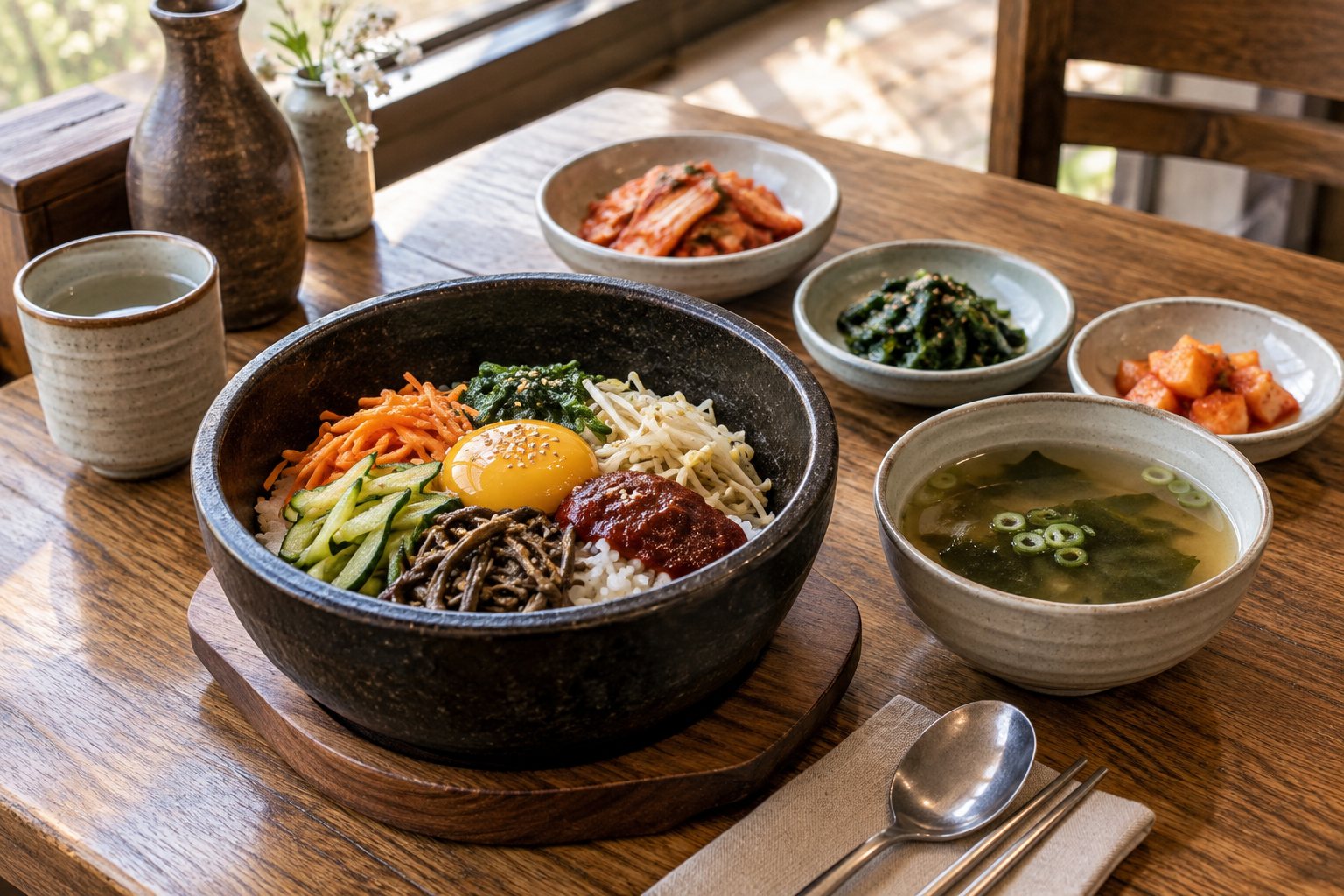
A Korean restaurant can put several small dishes on your table before you think you have ordered anything. Then nobody comes back with the bill. Both can be normal. The useful questions are what is included, how to order and where to pay.
Quick answer
Tipping is generally not expected at ordinary Korean restaurants. Basic banchan served with your meal are commonly included, but extra dishes, rice, premium sides and some refills can cost money. Check the menu, ask before adding anything, and follow the restaurant’s ordering and payment system.
Arrive, get a table and check the ordering system
At a staffed entrance, say how many people are eating and let the host seat you. At a casual shop, look for a waiting list, “please wait” sign or a staff gesture before taking an empty table. An empty-looking table may be reserved or still being cleared.
You might order with a server, at a counter, through a kiosk or on a table tablet. Some places ask for payment first; others settle the bill afterwards. Do not order again just because the process differs from home.
| What you see | What it means for you |
|---|---|
| 셀프 / self-service | The marked item is self-service. It may be water, utensils or a side-dish station—not necessarily the whole meal. |
| 주문 / order | Use this for placing an order on a kiosk or tablet. Check your basket before confirming. |
| 추가 / extra | An additional item or portion. Check the price before selecting it. |
| 1인분 / one serving | A price or quantity per serving. Look for minimum-order conditions. |
| 2인분 이상 / two servings or more | The listed item requires at least two servings; ask how it applies to your group. |
Are the side dishes free?
Banchan (반찬) are the small side dishes served alongside many Korean meals. Basic banchan brought as part of the meal are commonly included in its listed price. That does not mean everything in a small dish, every refill or every extra item is free.
Look for a self-service station or ask for the particular side you want. Take small amounts you will eat, use the provided serving utensils and do not return food from your table to a shared container. If there is no self-service sign, ask staff rather than helping yourself from the kitchen.
| Item | What to check |
|---|---|
| Basic banchan brought with the meal | Usually part of the meal; confirm if something was offered as a separate order. |
| Banchan refill | Often available, but premium items or venue-specific refills may be charged. |
| Rice, noodles or soup added later | May be a separately priced addition, even if another dish came with rice. |
| A small dish pictured on the menu | It could be a paid starter, not an included side. Read its name and price. |
이거 추가하면 돈 더 내야 해요? — “Does it cost extra to add this?” Point to the actual item. It is clearer than asking whether all side dishes are free.
Order the portion you actually want
A menu price might be per serving, per person, by weight or for a shared plate. Before comparing two restaurants, compare the same unit. For barbecue or a shared stew, check whether there is a minimum number of servings and whether rice is separate.
For example, if a menu lists ₩12,000 per serving and requires two servings, the food subtotal for that item is ₩24,000 before any extras. This is a calculation example, not a promise about current restaurant prices.
Pointing works well for choosing a labelled dish, but a photo cannot confirm allergens, meat stock, seafood ingredients or vegetarian suitability. Ask about the ingredient that matters to you; if staff cannot verify it, choose something they can confirm.
To get attention, use the call button if there is one, or say 저기요 (excuse me) at a normal audible volume. A neutral request is safer than calling every staff member 이모님, which is a familiar form of address and does not suit every person or setting.
During the meal: follow the setup you see
Water may be brought to you or available at a dispenser — and either way, it is free and unlimited. This trips up visitors from countries where restaurants routinely charge for bottled water: in Korea, paying for water at a sit-down restaurant essentially does not happen. Look for a 정수기 (water dispenser) along a wall, often with a stack of cups or a drawer of cups built into your table — help yourself and refill as needed, no need to ask permission. Utensils may be on the table, in a drawer underneath it or at a marked station. Look first, then ask. “Self-service water” does not mean you need to serve your own hot dishes.
At barbecue restaurants, staff may cook for you, start the grill and hand over, or expect you to cook. Ask 직접 구워야 해요? — “Do we cook it ourselves?” Do not guess whether raw food is ready from the fact that a timer beeped or somebody else stopped turning it.
Floor seating is used in some restaurants, but it is not a requirement of a Korean set meal. If you see a raised shoe-free area, take shoes off at its boundary; otherwise follow the room’s setup. Ask for a chair if floor seating is uncomfortable.
Paying, tipping and checking the bill
In many casual restaurants, you pay at the counter when leaving. In others, staff bring a terminal or you have already paid at a kiosk. Ask 계산은 어디서 해요? — “Where do I pay?” Check whether your table number or a paper bill is needed.
A tip is generally not expected. A listed service charge is part of that venue’s pricing, not proof that you owe an additional gratuity. Do not assume every hotel or upscale restaurant adds a fixed 10% charge; read the actual menu and bill.
| Korean | English |
|---|---|
| 물 좀 주세요. | Could I have some water? |
| 이거 하나 주세요. | One of this, please. |
| 덜 맵게 해 주세요. | Please make it less spicy. Not every dish can be adjusted. |
| 영수증 주세요. | A receipt, please. |
If you need separate payments, ask before the final transaction. Keep the receipt if a charge looks wrong, and ask staff to explain the item rather than assuming it is a tip or a fee for the banchan.
Quick answers before your first meal
Can I eat alone?
Yes, but check the menu and seating policy. A one-person noodle or rice meal is simpler than a shared dish with a two-serving minimum. Do not assume every restaurant will reduce its minimum for one guest.
Should I leave cash on the table?
For an ordinary meal, pay the stated bill through the restaurant’s payment process. There is normally no need to leave a tip.
Can I just ask for more kimchi?
Yes. Say 김치 좀 더 주세요 — “Some more kimchi, please.” If the menu or staff indicates a charge, decide whether you want the extra before it is served.
Sources and review
Reviewed 19 September 2026. This is a desk-researched guide, not a report of an in-person test. Official sources support the specific facts linked below; practical checklists and example phrases are Koriway’s editorial guidance.
- National Institute of Korean Language: restaurant lesson — Stable dining-language and tipping context; not a source for current prices or every restaurant’s policy.
- Korea Tourism Organization: Korean food — Background on Korean meals and side dishes.
Next: ordering at a café · ordering delivery · where to remove your shoes.
Leave a Reply