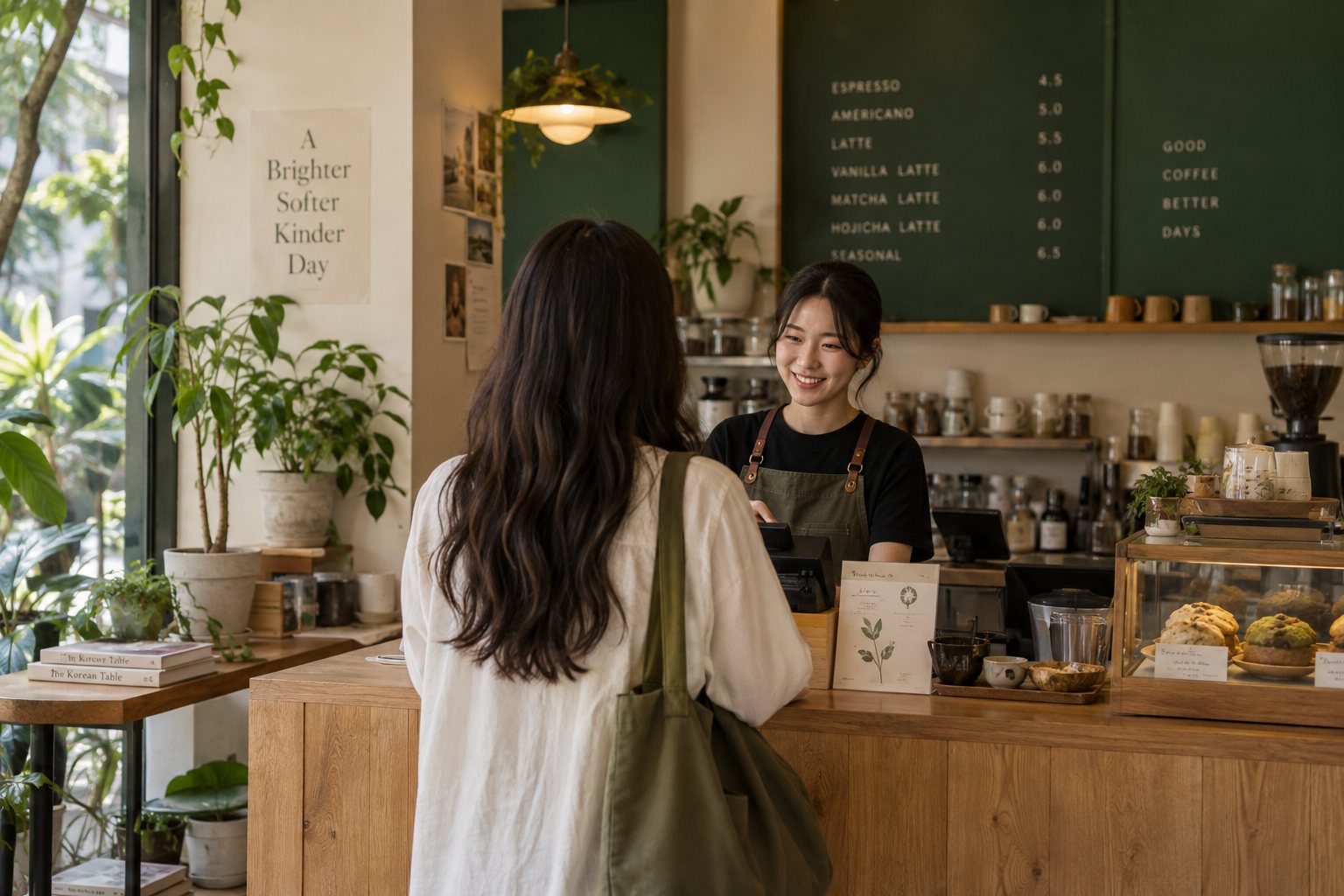
At a Korean café, the fastest question may arrive before your coffee: “For here or to go?” You do not need a full Korean conversation. You need to recognise a few choices, confirm your order and know where to collect it.
Quick answer
Choose your drink, hot or iced, size and whether you are staying. Order through the system the café uses—counter, kiosk, table tablet or server—and keep the receipt or pager for collection. Check the venue’s seating and laptop rules before settling in; one drink does not automatically buy unlimited table time.
One order you can say or show
아이스 아메리카노 한 잔 주세요.
“One iced Americano, please.”
Approximate pronunciation: a-i-seu a-me-ri-ka-no han jan ju-se-yo.
For a hot latte: 따뜻한 카페라테 한 잔 주세요. — “One hot café latte, please.” You can also point to a drink on the menu and say 이거 한 잔 주세요 — “One of this, please.” Showing the Korean sentence is useful when the shop is noisy.
| Korean on the screen or in the question | Your response |
|---|---|
| 매장 / 매장에서 드시나요? — for here? | 매장에서 마실게요. — I’ll drink it here. |
| 포장 / 가져가시나요? — to go? | 포장해 주세요. — To go, please. |
| 아이스 / 차가운 — iced or cold | 아이스로 주세요. — Iced, please. |
| 핫 / 따뜻한 — hot | 따뜻한 걸로 주세요. — Hot, please. |
| 사이즈 — size | Point to the listed size. Names and volumes differ between cafés. |
Use the kiosk without guessing at the final screen
- Look for a language button. Some machines offer English; others do not. The number of available languages is not consistent.
- Choose for here or takeaway when asked. Select the drink and check hot/iced, size and quantity.
- Read the options before adding extras. An extra espresso shot, syrup or alternative milk may have a charge.
- Review the basket and total. Remove accidental duplicate items before paying.
- Use a supported payment method, then wait for an order number or confirmation. Keep the receipt until you receive the drink.
If you get stuck, ask 주문 좀 도와주세요. — “Please help me order.” Show the current screen rather than starting a second order at the counter. If your bank reports a payment but there is no order confirmation, ask staff to check before paying again.
A translated menu photo helps identify an item, but it is not a reliable ingredient or allergy check. Ask about the specific ingredient you need to avoid. Drink names such as “latte” do not tell you every ingredient in a seasonal recipe.
Find out how to collect your drink
A café may give you a vibrating pager, print a number on the receipt, show a number on a screen or call the drink out. Stay within the shop’s collection area and watch the system it uses. If a pager is handed to you, keep it until collection and return it when asked.
Match the order number and drink before taking a cup. If you miss a call, show your receipt and ask 제 주문 나왔나요? — “Is my order ready?” Do not assume the first unattended drink on the counter is yours.
After finishing, look for a return station or return-tray sign. Separate cups, lids and leftover liquid according to that café’s setup. If staff clear tables, follow their guidance rather than searching behind the counter.
Seats, laptops and staying a while
Check the seating procedure before choosing a table. Some cafés want you to order first; others seat you or ask you to secure a seat before ordering. Neither rule applies to every Korean café.
| Check | Why it matters |
|---|---|
| Time limit or table policy | A posted limit can apply even if you buy a second drink. |
| Laptop rules | Some tables or entire venues restrict laptop use, especially when busy. |
| One order per person | Check whether each seated guest needs a qualifying order and whether dessert counts. |
| Wi-Fi and outlets | Availability is venue-specific. Ask for the network details and permission to use a socket. |
| Your belongings | Keep valuables with you. Other customers leaving bags on seats is not a guarantee of security. |
A study café is a separate type of venue, often organised around paid study time. Do not assume it offers ordinary café access, one universal hourly price or a signup/payment process that works with every visitor’s phone. Check its entry conditions before relying on it.
Prices and entry policies: read the actual notice
Compare the displayed drink, size and options. A low headline price may refer to a different size or takeaway offer. We do not list a nationwide “typical coffee price” as if it were the price on today’s menu.
With children, pets or a large group, check entry and seating notices before ordering. Some cafés have restrictions, and they vary by venue. The National Human Rights Commission has criticised blanket child exclusions in a specific case; that does not let a travel guide declare every restriction either lawful or unlawful. If a policy does not suit your group, choose a café that can accommodate you.
If you need help translating a sign, use a translation app while connected. NAVER’s Papago help distinguishes offline text/voice functions from image translation, which is not part of the offline feature. Save essential phrases before leaving reliable internet.
Quick café questions
Do I tip the barista?
Tipping is generally not expected in Korea. Pay the stated amount. A tip prompt or jar does not mean every customer is required to add a gratuity.
Can I stay for two hours with one drink?
There is no rule that covers every café. Read the time and seating policies, and ask staff if you plan to work for a while.
How do I ask whether a drink contains milk?
우유 들어가요? means “Does it contain milk?” If you have an allergy, explain that clearly as well and ask staff to confirm ingredients and preparation; a casual “no milk” answer is not a complete allergy assessment.
Sources and review
Reviewed 19 September 2026. This is a desk-researched guide, not a report of an in-person test. Official sources support the specific facts linked below; practical checklists and example phrases are Koriway’s editorial guidance.
- Korea Tourism Organization: food and tipping context — General tipping norm; individual menu and venue terms still apply.
- NAVER Papago: offline translation — Limits of offline translation, including image translation.
- National Human Rights Commission: child-exclusion decision — A 2017 discrimination recommendation; not a blanket statement of current café legality.
Keep going: restaurant ordering and side dishes · a small set of practical Korean phrases.
Leave a Reply